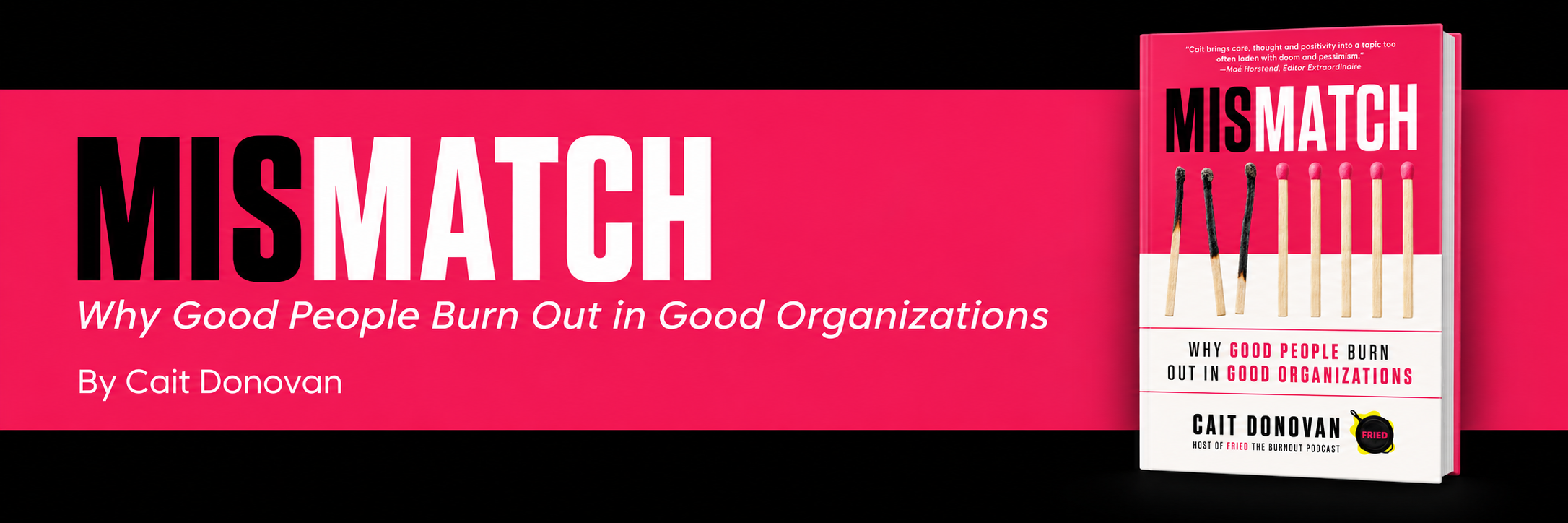
It’s not bad people
or bad companies.
It’s Mismatch.
We love to point fingers when it comes to burnout. Employees blame toxic companies. Companies blame disengaged employees. But after years spent studying burnout, Cait Donovan found the truth is rarely that simple.
With research-backed insight and her signature honesty and humor, Cait gives leaders and teams the tools to spot friction before it becomes a crisis, and to start fixing what’s actually broken instead of deciding who’s to blame.
Cait Donovan writes about burnout the way it actually feels: layered, personal, and rarely about just one thing. Mismatch gives leaders a real way to find where the gaps are in their culture, instead of another slogan about resilience.
What is Mismatch?
People + Roles
The gap between what a role asks of someone and what they can realistically give, sustain, or thrive within.
Values + Behaviour
The gap between the values an organization says it holds and what people actually experience day to day.
Expectations + Capacity
The gap between what leadership expects and what teams can actually carry with the time, tools, and resources they have.
Burnout needs more than another wellness fix.
Most burnout conversations eventually end up looking for someone to fix. The employee needs more resilience. The manager needs better training. The company needs another wellbeing initiative.
Mismatch takes a different approach. It treats burnout as a systems-level problem and looks for the places where people, roles, values, expectations, and capacity have stopped lining up.
Once you can see the mismatch, the problem stops feeling quite so impossible. You can start addressing what is actually creating the friction instead of guessing at the cause.
If work feels harder than it should, start here.
Leaders + Managers
Who can see friction building but aren’t sure where it’s coming from or what actually needs to change.
HR + People Professionals
Looking for a more useful way to understand burnout, disengagement, turnover, and misalignment.
Burnout + Wellbeing Professionals
Who want a framework that goes beyond individual resilience and surface-level wellness solutions.
Employees
Trying to understand why a job, team, or organization that once worked no longer seems to fit.
Organizations
Ready to stop guessing and start identifying what is actually driving burnout and friction.
A clearer way to see what’s actually going wrong.
Recognize mismatch earlier
Spot the friction before it becomes chronic burnout, disengagement, or turnover.
See where misalignment lives
Identify gaps between people, roles, teams, values, expectations, and organizational systems.
Talk about what isn’t working without blame
Use clearer language to name misalignment without turning the conversation into a search for a villain.
Ask better questions
Move from vague frustration to the questions that help people understand what actually needs to change.
Understand shared responsibility
See how employees, leaders, and organizations each play a role in moving toward better alignment.
Find a clearer next step
Turn problems that have felt unsolvable into something more specific, visible, and actionable.
People are already seeing burnout differently.
“Cait Donovan makes a case I haven't seen made this clearly: burnout isn't about doing too much, it's about not feeling like you matter. This book replaces blame with something rarer — actionable hope.”
“Mismatch is the rare book that helps you understand burnout without anyone getting blamed for it. The simple, repeatable tools and self-checks built right into the chapters mean you don't just read this book, you do it. That makes it just as useful for team members as it is for the leaders trying to support them.”
“One of the most healing ideas in Mismatch is also the simplest: burnout isn't a personal failing, it's a pile-up of mismatches between you and your environment. Cait Donovan replaces shame with clarity, and gives you an actual map for what to fix and where.”
Stop guessing.
Find the mismatch.
Cait Donovan knows burnout from more than one angle.
Cait Donovan is a speaker, bestselling author, and host of FRIED. The Burnout Podcast.
She brings rare clinical depth to the burnout conversation, with a background in biobehavioral health science, more than 30,000 acupuncture treatments given, and years spent studying what burnout actually looks like in real people and real workplaces.

Put Mismatch
in more hands.
Looking for copies for your leadership team, employees, members, clients, or event attendees?
Corporate and bulk preorder options are available directly through Cait’s team, with additional ways to bring the ideas in Mismatch into your organization.
Start with the books.
Or build something around them.
Whether you need a larger book order or want to pair the book with a conversation, Q&A, keynote, or workshop, we can help you find the option that makes sense for your organization.
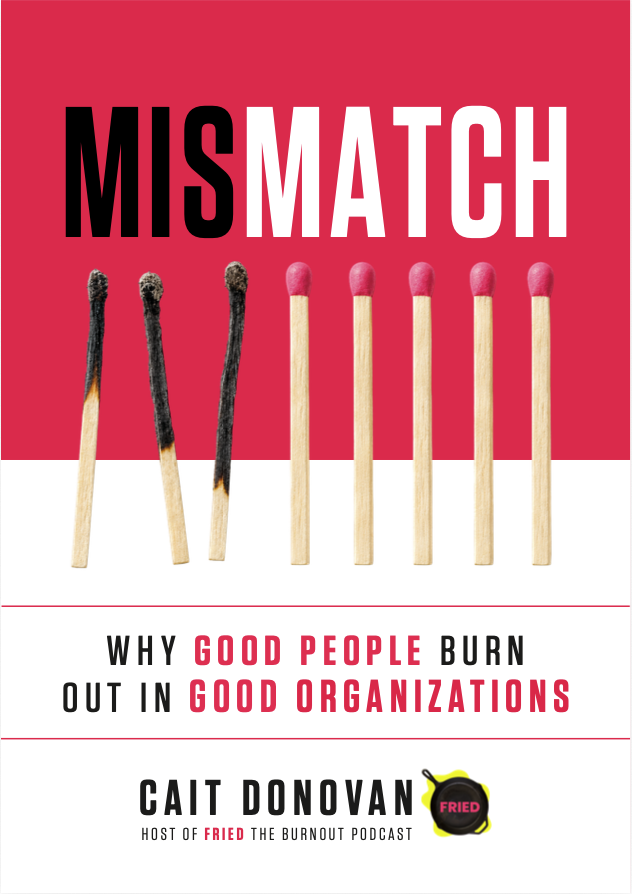
Mismatch
You’ve probably blamed the workload. The tools. The always-on culture. The manager. The employee who isn’t resilient enough.
But the root cause was never one thing. It’s a series of mismatches between people and their roles, stated values and actual behaviour, leadership expectations and what teams can actually carry.
In this keynote, Cait uses her Blameless Burnout™ Middle Out method to locate the mismatch, name it without blame, and treat it at the root together.
Burnout looks different when you stop looking for someone to blame.
“Mismatch names something so many of us, and my patients, have felt but didn’t have a name for: that burnout isn’t a personal failure or only about the system- sometimes it’s simply the wrong fit between a good person and a good organization. Donovan’s framework is clarifying and immediately useful, giving leaders and employees a new way to figure out what is going wrong and address it, rather than hiding behind wellness programs and employee appreciation days. This book will change how you think about talent, culture, and fit, both for yourself within an organization and for your team with you.”
“Good people and good organizations still experience bad things. The mismatch comes when we apply a value judgment to the people instead of addressing the real problem. Mismatch helps leaders stop moralizing burnout and start understanding what’s actually causing it.
Cait Donovan dives in (and I mean deep) without penalizing leaders or shaming those experiencing burnout. She swims through psychology, Eastern medicine, professional experience, and the daily realities readers will recognize in themselves and their workplaces, so we can collectively heal and foster better-matched workplace environments.”
Good people.
Good organizations.
So why are people still burning out?